
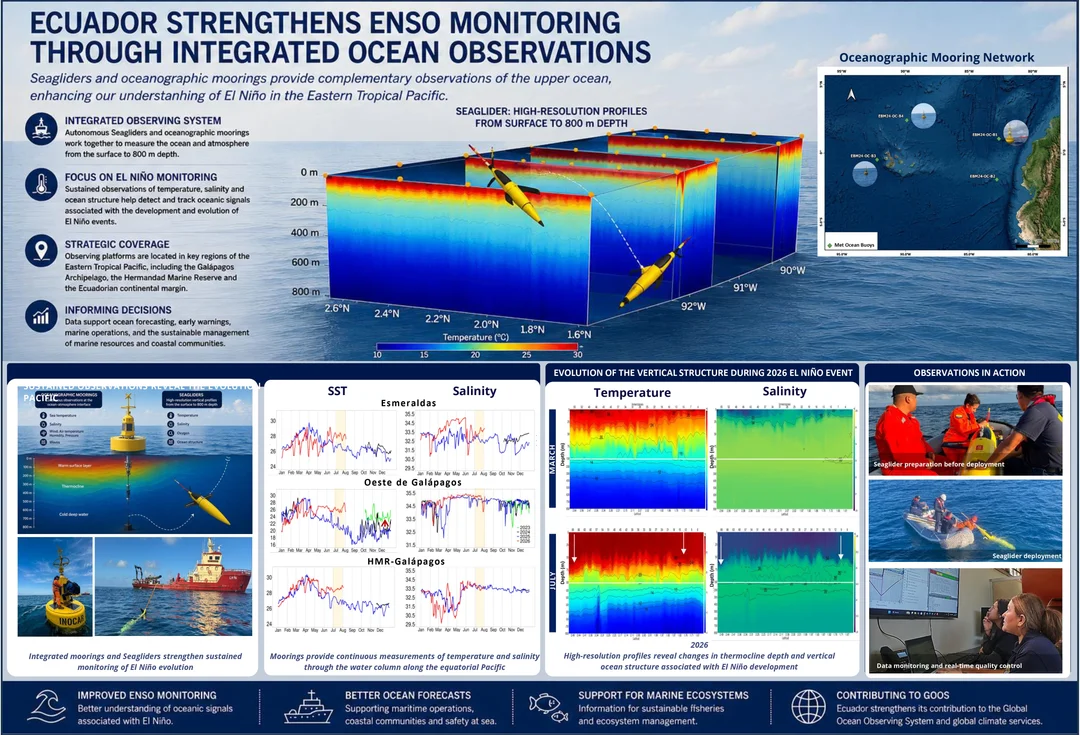
Sustained ocean observations are essential for tracking the evolution of El Niño–Southern Oscillation (ENSO), particularly in the Eastern Tropical Pacific, where changes in temperature, salinity, thermocline depth, and upper-ocean stratification reflect the regional expression of basin-scale ocean–atmosphere variability.
To strengthen Ecuador's contribution to sustained ocean observing in this climatically sensitive region, the Oceanographic and Antarctic Institute of the Ecuadorian Navy (INOCAR) deployed the autonomous Seaglider SG535 in the Hermandad Marine Reserve in late July 2026. The mission continues the observational record initiated by Seaglider SG614, which collected repeated high-resolution profiles between March and June 2026.
The oceanographic campaign was conducted by Dr. Pritha Tutasi, Marcela Córdova, and Xiomara Matías from INOCAR's Department of Oceanography and Marine Meteorology. The Seaglider was deployed from the Ecuadorian Navy research launch LAE Sirius, with operational support from the Insular Hydrographic and Oceanographic Service (SHOIAR).
Over the following two months, SG535 will repeatedly profile the water column from the surface to approximately 800 m depth, providing high-resolution observations of temperature, salinity, and chlorophyll fluorescence. These measurements resolve changes in vertical ocean structure that are poorly captured by surface observations alone, including variations in thermocline depth and stratification that are relevant for characterizing the regional oceanic response to evolving ENSO conditions.

The Seaglider observations complement INOCAR's network of three oceanographic moorings located at key sites in the Eastern Tropical Pacific: within the Hermandad Marine Reserve, off Esmeraldas along Ecuador's continental margin, and west of the Galápagos Archipelago. The moorings provide sustained time series at fixed locations, while the Seagliders resolve the vertical and spatial structure of the water column. Together, these complementary observing approaches improve the capacity to detect and track changes in ocean conditions associated with ENSO.
Initial Seaglider observations from the 2026 missions reveal marked changes in the vertical thermal structure between March and July, including a deeper thermocline and warmer near-surface waters in July. These observations are being evaluated together with INOCAR's mooring records and other regional ocean–atmosphere indicators to distinguish seasonal variability from signals associated with the evolving ENSO conditions. The observations have also contributed to the technical information considered by Ecuador's ERFEN Committee in its national assessment of ENSO conditions.
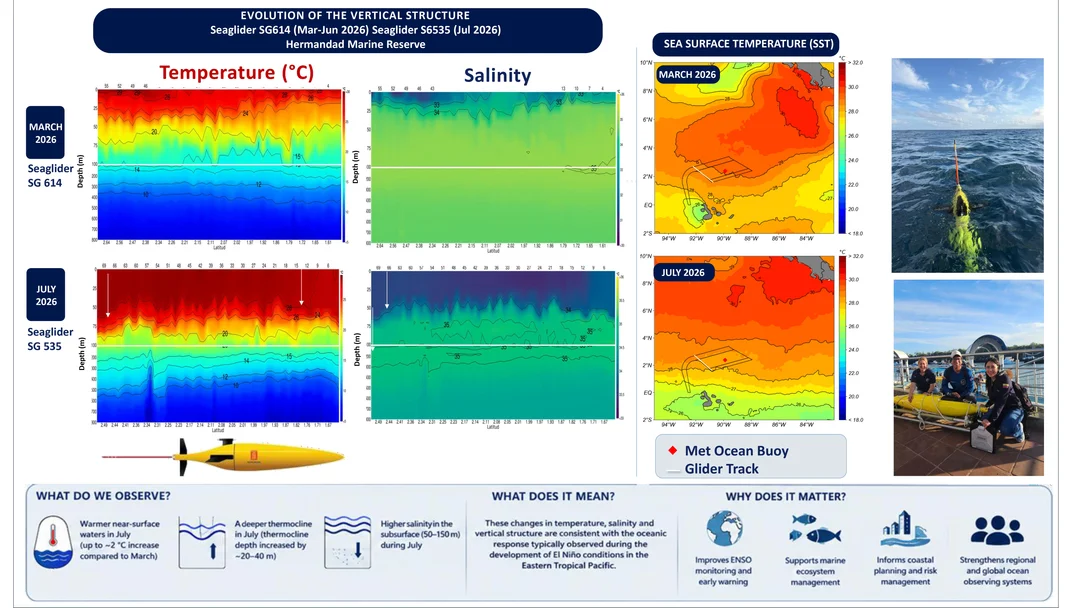
Autonomous underwater gliders and oceanographic moorings provide subsurface information that cannot be resolved by satellite observations alone. When combined with satellite products and other components of the observing system, these measurements provide a more complete description of ocean variability, supporting ENSO monitoring, operational oceanography, marine ecosystem assessment, and climate services.
Through this integrated approach, INOCAR is strengthening Ecuador's sustained ocean observing capabilities and contributing observations from a strategically important and historically undersampled region of the Eastern Tropical Pacific to regional and global ocean observing efforts.
